
Our summer cruise took us first into South Sound, then back to Port Townsend to welcome the Seventy48 human-powered teams from Tacoma and to see off the Race to Alaska (and to pick up passports and new house batteries). Then we escaped north to the Broughtons for another four weeks. Here’s our itinerary, along with practical notes.
Thursday, June 2, 2022 – Blake Island State Park
On the agreed departure date we’re off. South because we’re still without passports. The autopilot is wonky, so Jack keeps his hands on the wheel. It’s a beautiful day and the waters off Point No Point behave. We need this.
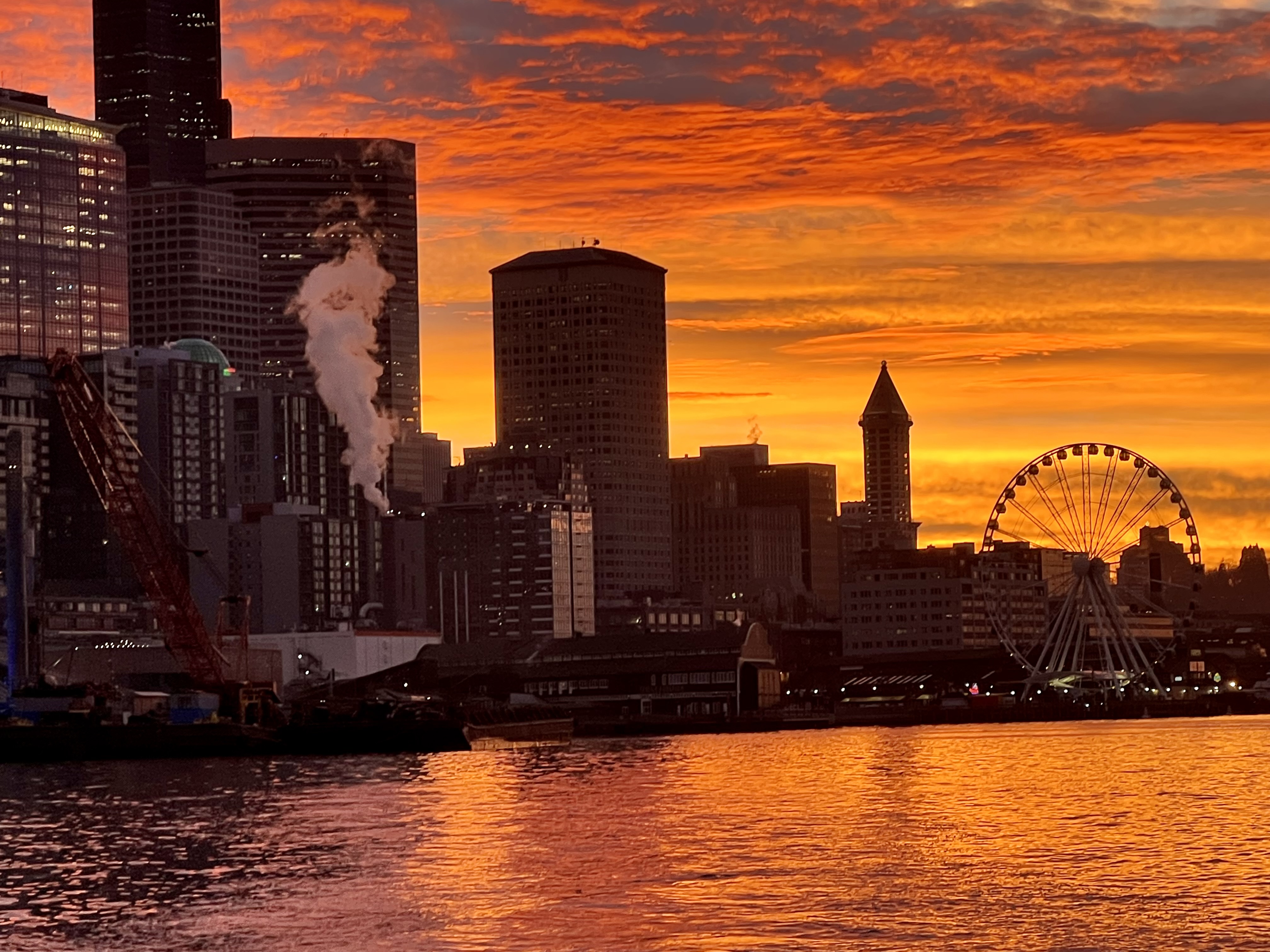
We’re the only boat on a Washington Parks buoy with a view of the sun setting on Seattle. The park ranger visits. He’s worked at this park for 24 years and we have a nice chat. I hand over a check for $12, explaining that we’re short-handed and sometimes I just mail in the moorage fee.
Friday, June 3 – Filuchy Bay, Key Peninsula, South Puget Sound
As soon as we’re through the Tacoma Narrows, there’s more open water and shore. In lovely Filuchy Bay, we’re the only visiting boat. three nights, mostly in gentle rain, we notice the bulk order from Key City Fish filling our freezer is getting soft. And the oven won’t light though the burners and broiler work fine. After Jack turns on the generator to juice things up, I go below to look at the house batteries. They look very tired.
Monday, June 6. Elliott Bay Marina, Seattle
We head north in search of four replacement house batteries. Elliott Bay Marina is a sad, corporate place full of little-used, expensively-maintained boats. The marine services say they could probably get to our job in several weeks – it’s the summer season, what do we expect? Jack makes a short call to Sea Marine back in our Point Hudson neighborhood and Jeremy is on it.
Tuesday, June 7 – Port Townsend
Four AGM batteries are on their way to Port Townsend. We move home. By now Point Hudson is full of energy and anticipation. What a time to be here – the adventure races! I sign up to work the Seventy48 finish line. On Friday night, racers depart from Tacoma for the 70 miles to be completed in 48 hours, no sails, only human muscle. I urge finishers over the line with my nautical Indus River cow bells and blow the horn as the racers – friends and strangers, amateurs and professionals, old and young – cross over to personal or public victory. The Race to Alaska competitors are arriving from all over the world, their strange craft filling “Pope John” park and the marina. We eschew The Ruckus to go to Fort Worden for the wildly innovative dance performance by Bill and Don, our next-door neighbors, and their group. At 5 am Monday, we gather with hundreds of other for the R2AK start. Conditions on the Strait leave the rowers, peddlers, and paddlers camping on the Dungeness Spit while the faster boats struggle. There are an unprecedented four capsizes and I fall into full Tracker Junkie mode. While the passports and batteries arrive., I catch up with housing + sanitation work, including a Juneteenth/Father’s Day HSN benefit at the Pourhouse, after which we crawl into our berth on Morning Light.
Monday, June 20 – Prevost Harbor, Stuart Island, San Juan County, WA
Point Wilson kicks up and it’s pretty awful most of the way to Haro Strait.
We head to Stuart Island, Prevost Harbor this time. For an early morning crossing of the Boundary Channel, Prevost affords a good view of the shipping lanes. We cross without incident and tie up at the summertime Canadian Customs dock in Bedwell Harbour on South Pender Island. We notice the new scooter accessible ramp, something Jack had advocated for with Ottawa officials. Yea! Everything is in order, though we can’t upload the covid-lockdown-era pre-registration phone app known bilingually as ArriveCAN. Absurdly, the folks on the phone in Ottawa insist we need it and turn us away. “BTW please don’t come back until you’ve verified you have officially re-entered the United States.” What!?
Tuesday, June 21 – Friday Harbor, San Juan Island
So we journey to Friday Harbor and trudge uphill to the newly relocated office of Customs and Border Protection. A kind official runs us through their new, fairly intuitive process and helps us sign up for the CBP-Roam app to enter the United States. We’re good. Back to Morning Light to cook supper while we take advantage of good Internet to figure out the Canadian app. This time success.
Wednesday, June 22 – Ladysmith Maritime Society, Vancouver Island, BC
The visitors’ dock at the Van Isle Marina is spiffy. It has fuel, groceries, a small Canadian Customs phone kiosk, and welcoming, uniformed staff busy watering the hanging baskets that echo the pride this part of The Island has in their flower gardens. Jack quickly gets our clearance number and we’re off to LMS, a fine small non-profit marina-museum-small boat center-Purple Martin breeding station-café amid the activity of small tugs assembling log booms and noise of the neighboring lumber mill. To our astonishment, nearly half the boats are Nordic Tugs.
Thursday, June 23 – Nanaimo, Vancouver Island
The Harbour Authority assigns us to the fishing boat dock with Trollers fish and chip place at its head and buskers on the promenade from noon till dark. Here also are a bunch of Nordic Tugs, again mostly Canadian, with a few from Ladysmith. Lil Moe from Orcas Island is nearby so Jack throws the shipper a question about the autopilot malfunction. Gordon comes back with a veritable mechanic’s checklist. All okay until he says, “Well, then maybe there’s something metal in the compartment under the sink in the head. Oops. Neglecting the clear label NOTHING METAL IN THIS COMPARTMENT I’d stashed the pretty useless plastic mini vacuum cleaner that came with the boat there – along with its AC power charging cord with its heavy “lump in the snake” that was driving the compass nuts. Mea culpa! Problem solves.
Saturday, June 25 – Boho Bay, Lesquiti Island
Ah, Lesquiti! Wild Georgia Strait Island, long a home to smugglers, misfits, Vietnam War draftees, and contemporary off-gridders. And there it sits in the middle of Georgia Strait, between the two great metropolitan areas of British Columbia and somewhat sheltered by the long mountainous spine of Texada Island. Vacation begins in earnest.
Sunday June 26 – Tribune Bay, Hornby Island
The perfect day and night for this lovely bay and spectacular beach.
Monday, June 27 – Comox, Vancouver Island
Early morning trip around Chrome Island light, up Baynes Channel, past the Royton Wrecks, and into Comox Harbor. No response from anyone on VHF or phone, so we pulled into the fuel dock. No room on their docks but the guy at the marina next door called us down to a sweet spot right in next to the office and the marina gate with a view of the launch ramp! Our first time here I remember sitting in the pub that’s since burned down, catching bits of beach volleyball at the summer Olympics while watching the parade of people up and down that ramp in every manner of small craft. Even better this time. Then in the evening about sixty paddle-carrying, mostly old folks in bathing suits and life jackets came through the gate for Dragon Boat practice.
Tuesday, June 28 – Campbell River, Vancouver Island
Jack got the timing right on the currents past Cape Mudge, and we settled into our slip after a stop at the fuel dock, our first since April. Time here spent provisioning (including from BC Liquors, which is no longer near the head of the docks), laundry, catching up on mail, and a visit to Riptide Pub.
Thursday, June 30 – Shoal Bay, East Thurlow Island
I love the anticipation of motoring Cordero Channel between Frederick and Philips Arms and rounding the point for the first glimpse of the wharf. Boats rafted three on either side or lots of room for us? The latter. At one point. we were the only boat. Mark came down and greeted us.
Friday, July 1 – Cutter Cove, British Columbia Mainland
Our first time in this well-located cove off Chatham Channel with a view of the former Minstrel Island Resort and boats turning into the Hole in the Wall. A bit of rocking but we hold well.
Saturday, July 2 – Waddington Bay, The Broughtons
At last, we reach the perfect Broughtons anchorage. Even better with a long paddle board tour when the high tide multiplies the number of islets all around.
Tuesday, July 4 – Echo Bay, Gifford Island
Strangely empty despite the new ownership by the K’iwaxwalawadi First Nation and the promise of cultural tourism and construction of a new path to Billy Proctor’s Museum underway. Seems cruisers still expect pig roasts and liquor in the convenience store. We’ve rarely stopped at Pierre’s owing to access issues, but now Echo Bay needs our business. All around the Broughtons old logging camps are turning into fly-in fishing resorts without visitor moorage. Kwatsi Bay on Tribune Channel has been sold and the docks are being reclaimed by Nature. The nearby anchorage is deep and lies beneath a potential rock slide. And you never know in which potential emergency anchorage a fish farm or a logging camp has suddenly appeared.
Wednesday, July 5 – Port Harvey, West Cracroft Island
Plans to motor through the spectacular high steeped cliffs of Tribune Channel are jettisoned as fog robs the view. From Knight Inlet, we turn into Lagoon Cove for water and to meet the lovely new owners. Boats come and go but there’s no need for the Mediterranean moorage to pack boats in as in earlier summers. Proceeding back through Chatham Narrows and Havannah Channel we anchor at Port Harvey, in front of George and Gayle’s old place, which seems in good condition. I hope someone will again welcome visitors from or enroute to what can be a bruising passage of Johnstone Strait.
Wednesday, July 6 – Thurston Bay Marine Park, Sonora Island
Johnstone Strait is perfect this morning so we stay with it rather than turn into Wellbore Channel to take the inside Inside route via the rapids and Cordero Channel. A spectacular passage takes us into Nodales Channel and on to Thurston Bay.
It’s our first-time visit to this undeveloped marine park. Wow. How did we miss it? Northbound we noticed boats and decided to give it a try. A couple of other boats come and go. We leave the Bay majestically empty on departure.
Gorge Harbour on Cortes Island is a favorite place but they have no room for us. For the first time our go-with-the-flow-no-reservations policy fails but George Harbour deserves to be full. The fully accessible resort consists of a small marina. a family camp ground, and between them a pool, hot tub, sand vollyball court, waterside picnic area, tiered lawn with gardens, restaurant with deck, and a meandering stream. Seven AM yoga brings together staff and guests. Musicians gather in the evening.
Friday, July 8 – Rebecca Spit, Quadra Island
We arrive via beautiful Okisollo Channel, which connects Discovery Channel with the Discovery Islands via Surge Narrows, another inside-the-Inside Passage route. Beazley Passage through the narrows at slack turns out to be a nothing burger. Octopus Islands along the way are full of anchorages.
We drop anchor in the sweet spot just inside Drew Harbor where the ferry to Cortes and smaller vessel traffic fail to rock your boat.
Saturday, July 9 – Comox, Vancouver Island
We’ve been wondering if our holding tank is empty or not. Our gauge is on the blink and we know the consequences of not knowing: the tank overflows when you unscrew the cap. I find it shocking that there are no pump-out facilities in the Discovery Islands, despite vast no dumping zones.
Our literature confirms that Comox has one so we head there. Again, no one answers on ?? 78A so we just pull into Fisherman’s Wharf and take a place on D dock. Turns out, that’s what you’re expected to do. No reservations. First come, first serve. Harbour Authority staffer Janet is exceptionally energetic about finding space. When an 80-foot Channel Islands-flagged yacht asks to be squeezed in, Janet goes into action, measuring spaces between docked boats, readjusting lines, and asking skippers to move. With a mere yard to spare at bow and stern, it takes the professional crew 20 minutes to get the behemoth to dock.
As for the pumpout, it’s productive. The tank had indeed emptied in the middle of Johnstone Strait and now the green “empty” light on the gauge comes on. Still, the process was peculiar. In Comox, the pump unit is under lock and key, you pay $10, schedule it between 10 am and 5 pm, and they do it for you!
Janet explains that the fishermen – “they never pump out”- purchased the unit for $300,000 (presumably so that their Wharf could enjoy Clean Marina status). And now they don’t want anything to happen to it. In the three years since its installation, the Harbour Authority has only done about 50 pump-outs. While this defeats most purposes, an advantage is that Canadians learn to do something unfamiliar and possibly quite intimidating. In general, people have trouble unlearning the former rule that “the solution to pollution is dilution.”
Once Morning Light is tied up on port on the red toe rail, Janet appears with the key to the pump pedestal and the teenage dock hand that she’s training. They are gloveless, so I say “How about I do it?” and recommend rubber dishwashing gloves that go to the forearm. Here’s the drill:
Put the end of the hose in the deck fitting. (It fits vertically),Wait for the machine to be turned on.
Open the valve in the hose.
Watch through the (utterly clear) plastic window.
Close valve when done.
Leave in place until the pump is turned off.
Lay hose down with the nozzle into the water.
Get the fresh water hose let clean water run into your holding tank for a minute or two.
Remove fresh water hose and re-fit pump nozzle.
Wait for the machine to start.
Open the value.
Pump it out again.
Close the valve.
Wait for the machine to turn off.
Wash off the nozzle in seawater.
Coil hose and hang it on the pump pedestal.
The directions work perfectly in three-person harmony. Not a drop of Morning Light’s shit lost between holding tank and the Comox municipal sewer.
Monday, July 11 – Montaque Harbour, Galiano Island
Montague Harbour Marine Provincial Park is filled with boats, dinghies, and paddle boards used in creative ways: Ferrying a dog to or picnic cooler to shore, three folks relaxing on a 12.5 foot board, efficient paddlers paired with seated passengers. Suddenly there are people all around to help if something goes wrong.
This is an ideal time to quit being lazy, winch the inflatable dinghy down, see if I can get the outboard going, and practice driving the thing. I want to see if I can do it single-handedly, which means getting the sequence right and adding a couple of steps. I take the covers off boat and crane, remove the red plastic gas tank to lessen the weight, undo the lines that secure the boat on its chocks, check the condition of the three-point harness, attach the block on the boom to the harness and snug it up, remove the starboard stanchions and lifelines of the salon deck, winch the boat up, push out the boom out over the water, use the stern line to pull the dinghy beyond the mast shroud, ease the line on the mast winch, ease the line on the boom winch, gently lay the boat in the water, and hook up the gas tank. Done!
Now to smooth out my hate-love relationship with outboards, I go over the start sequence several times until I finally get it right and the motor comes to life. I head slowly to the park dock and crash into it. A guy jumps off his boat, asks if he can help, and points out that there’s not too much harm you can do crash landing an inflatable. True. I keep that in mind.
Time for a walk. I climb the ramp to the pay station, fill in the info on the envelope, add ten loonies and four US greenbacks, and drop it in the slot of the steel box. Then I head down to the lagoon that leads to a vast white shell beach, a First Nations midden likely used for centuries. A few overhanging trees shade folding chairs and people reading books or gazing out at the boats rocking gently on their anchors. This is the quiet side of the Park.
As I remember, land campers at Montague Harbour used to drive to their sites on rough dirt roads. Now it’s bike or walk-in only. While marveling at the comfortable setups – some for multiple families spending a week or two – I notice the hidden parking lot from which tents and supplies are brought up the hill on park-provided carts. So much better! Sites are permanently equipped with good tables, tent platforms, charcoal fire pits with braziers, and raccoon-detering food protection boxes. Water spigots and clean dry toilets are nearby. I note a young mom working remotely on her phone while watching her toddler playing in the beautiful woods all around their campsite. Just another reminder of how restricting cars can create lovely, safe, shared spaces.
The next afternoon, I face the next challenge: getting the inflatable back up on the salon deck. Reversing my steps now, I add a couple: I tilt the motor out of the water to better distribute the weight and add another line to the stern to steady the operation as the winds come up. Little by little, I winch up the boat and the boom and lay the boat in its cradle. Success feels very good indeed.
Thursday, July 14 – Roche Harbour Resort, San Juan Island
It’s time to go back to the USA and Jack has the tides, currents, and navigation worked out. I’m making good progress reviewing Navionics and learning Vesper, which links to it, showing all AIS emitting vessels around us. We approach Boundary Channel shipping lanes as they bend at a 70º angle around Turn Point on Stuart Island. Perfect timing takes us between a Vancouver-bound Evergreen container ship and an outbound bulk carrier. When we get AT&T service, we use our CBP-ROAM app to pass customs. After a short video call to ascertain that our faces match the embedded passports, the line starts breaking up. The US customs official phones to ask the questions. This year CBP is worried about citrus. We report one orange and one lemon. “Consume them in the islands,” the guy says, “Don’t take them to the mainland.”
The next call is to Roche Harbor, a place we go every year, usually off-season, but having missed Gorge Harbour Resort, we’ve substituted a night here. “Do you have space?” “Yes, likely.” We rock across Spiden Channel, turn into the bay, and call again. It’s only 10:30 am so dock staff is still figuring out who is leaving and who is staying. We drop anchor, watch the parade of boats in and out, have lunch, and check again. “Finger 8 east side, stern in, port tie.” We’re told it’s a tight spot but someone will be there to help with the lines. As I am switching fenders and lines from starboard to port, we turn into the sea of huge plastic yachts that is Roche in the summer. With a foot or two clearance, Jack squeezes into a tiny space surrounded by towering white boats.
Friday, July 15 – Watmough Bay, Lopez Island
The currents in Spiden Channel are always confused but never more so than during a spring tide. On top of the watery chaos, boats are making unpredictable movements, probably owing to new owners still ignorant of the rules of the road. For someone who cannot drive a car on a highway without imagining death at every passing vehicle, the San Juans in the summer are not fun (though boat collisions are extremely rare). Helping Jack track AIS “targets”, I survive Harney Channel and Thatcher Pass. Then we break out on broad empty Rosario Strait and drop anchor in Watmough Bay. The residents of Lopez Island have fought mightily to preserve their land and access to the sea. This anchorage – the nearest to Port Townsend is the San Juans – is an exquisite example of their success. I was delighted to see that the 2022 Wagonner gives it only a passing mention.
Saturday, July 16 – Port Townsend
“Lopez Point” was boiling as spring ebbs collided with spring floods. Once out in Straits, the waters relaxed and we rounded Point Wilson in something resembling slack. We crept into Boat Haven with 6 feet under our keel and tied up in B95, our home slip. What a splendid summer cruise!


Leave a Reply